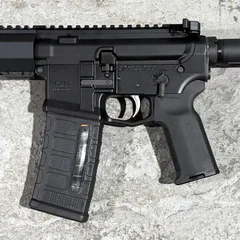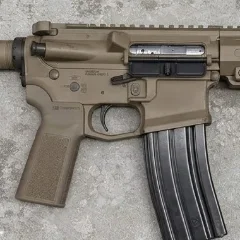
Ask a room full of 6mm ARC shooters for the ideal barrel length and you will start an argument. Ask which length they keep coming back to, and a surprising number give the same answer: twelve and a half inches.
The case was made most plainly in an r/6ARC thread titled “My argument for the 12.5" 6mm ARC barrel as the ideal ‘do-all’ length.” The original post has since been deleted, but the replies are still there, and they split along predictable lines. One side ran the numbers and could not believe how little the cartridge gives up. The other side wanted more velocity for hunting, more consistency at 800 yards and a shorter suppressor instead of a shorter barrel. Both sides had a point, and this file takes both seriously.
“6 arc takes to short barrels like nothing I’ve ever seen.”r/6ARC, the “do-all” thread
Quadradyn has a stake in the answer, so here it is up front: the 12.5" 6 ARC is what we build. The ICAR-magazine compatible SARC-6, the EL CHEAPO 6 and our standalone QMB-6 12.5-inch 6mm ARC barrel all run the same length and the same 1:7 twist. We did not land there by accident. This file shows the work: what 12.5 inches costs, what it keeps, where it falls short, and how few companies are willing to build it at all.
For one rifle that has to do everything, suppressed, 12.5 inches is as close to perfect as 6mm ARC gets. For a dedicated long-range rifle, or a deer rifle for shots past 400 yards, it is not, and nobody should pretend otherwise.
The do-all argument
The argument starts with the cartridge. Hornady built 6mm ARC to launch long, high-ballistic-coefficient 6mm bullets from an AR-15-size rifle, after a specialized Department of Defense group asked for more reach than 5.56 without the weight and recoil of .308. A high-BC bullet holds its speed after it leaves the muzzle. That lets the cartridge give up some muzzle velocity and still carry farther, flatter and harder than 5.56 does from a longer barrel. It is also why the short-barrel conversation is different for 6mm ARC rifles than for 5.56: the cartridge’s main advantage lives in the bullet, not in the last few inches of the barrel.
One r/ar15 member charted factory data for a 12.5-inch 6 ARC against a 16-inch 5.56 firing 77-grain match ammunition, a favorite heavy load for the AR-15, and came away with a line that sums up the case for the short barrel: “I could run an SBR that outperforms a typical 556 rifle in every way.” Their chart had the shorter 6 ARC ahead on energy at every range, with more supersonic reach and less wind drift.
The other half of the argument is length. Suppressors are becoming standard equipment rather than accessories, and a can adds several inches to the front of the rifle. Start at 16 or 18 inches and a suppressed 6 ARC gets long in a hurry. Start at 12.5 and the complete rifle stays close to the size of an unsuppressed carbine. That is the thesis in one sentence: keep the cartridge’s reach, lose the length.
What 12.5 inches actually costs
Velocity first, because velocity is what a shorter barrel takes away. Hornady’s gas-gun load data for 108- to 110-grain bullets includes a barrel-length projection for maximum-charge loads, developed in an 18-inch Noveske test rifle at up to 52,000 psi. Read on its higher-velocity side, with 12.5 and 14.5 inches interpolated, it looks like this:
| Barrel | Reference velocity | Muzzle energy, 108 gr | Versus 12.5 in. |
|---|---|---|---|
| 12.5 in. (interpolated) | 2,365 fps | 1,341 ft-lb | - |
| 14.5 in. (interpolated) | 2,450 fps | 1,439 ft-lb | +85 fps |
| 16 in. | 2,505 fps | 1,505 ft-lb | +140 fps |
| 18 in. | 2,575 fps | 1,590 ft-lb | +210 fps |
| 20 in. | 2,635 fps | 1,665 ft-lb | +270 fps |
| 24 in. | 2,740 fps | 1,800 ft-lb | +375 fps |
Two things stand out. The loss is real: a 12.5-inch barrel gives up about 210 fps to an 18-inch barrel and about 270 fps to a 20-inch barrel. And it is much smaller than the length you remove. Cutting a 20-inch barrel to 12.5 removes more than a third of the barrel and costs about 10 percent of the velocity, and every inch you add back buys a little less than the one before it: around 40 fps per inch between 12 and 14 inches, closer to 30 between 18 and 20.
Those are handload projections, not promises, so check them against factory ammunition. Owner reviews put Hornady’s 108-grain factory load at about 2,315 to 2,365 fps from 12.5-inch Shaw and Faxon barrels. Published reviews of the same load have recorded 2,559 and 2,661 fps from 18-inch rifles and 2,633 fps from a 16-inch, and RECOIL clocked a 108-grain load at 2,445 fps from a 14.5-inch barrel, within 5 fps of the table’s interpolated 2,450. In the real world, then, the gap between 12.5 and 18 inches runs roughly 200 to 350 fps depending on the rifle, and the do-all thread tells the same story: one commenter put 12.5 against 18 inches at 2,350 versus 2,600 fps, and an owner wrote that their 12.5-inch Shaw barrel runs only about 200 fps slower than their 22-inch Shaw. Your rifle, your ammunition lot, as described in Unchambered, and your chronograph are the only numbers that count, but nobody is reporting a 12.5-inch 6 ARC that falls off a cliff.
One reply offered a tidy explanation for why 12.5 works so well: “The golden rule is that you want 90% powder burn and 75% gas expansion, and 6 ARC achieves that around inch 12.5.” It is a satisfying sentence. It is not a rule. Burn rate belongs to the propellant and the conditions it burns in, not to a cartridge name, as described in Unchambered, and we know of no published standard or test method behind either percentage. The real reason 12.5 inches works is simpler and better supported: the bullet. A 108-grain match bullet with a G7 ballistic coefficient around .270 sheds speed slowly, so a modest deficit at the muzzle stays modest all the way downrange. That is the bullet class the 1:7-twist SARC-6 is built around; its spec readout lists 90 to 108 grains.
What happens after the muzzle
A chronograph number is only the start. What matters is what the bullet is still doing at 300, 500 and 800 yards. We ran Hornady’s 108-grain ELD Match through a standard point-mass model with a G7 ballistic coefficient of .270, at each barrel length’s reference velocity. As a check, starting from Hornady’s 24-inch factory rating of 2,750 fps, the same model gives 1,959 fps at 500 yards against Hornady’s published 1,971, a difference of less than 1 percent.
| Barrel | 1,000 ft-lb out to | 1,800 fps out to | Supersonic to | 800 yd: drop / 10 mph wind |
|---|---|---|---|---|
| 12.5 in. | ~210 yd | ~380 yd | ~935 yd | 9.1 mil / 66 in. |
| 14.5 in. | ~265 yd | ~435 yd | ~990 yd | 8.3 mil / 62 in. |
| 16 in. | ~300 yd | ~470 yd | ~1,020 yd | 7.9 mil / 60 in. |
| 18 in. | ~340 yd | ~510 yd | ~1,065 yd | 7.4 mil / 57 in. |
| 20 in. | ~375 yd | ~545 yd | ~1,100 yd | 7.0 mil / 55 in. |
Read the table the way the thread argued about it. One shooter claimed that going from 12.5 to 18 inches “only gains you 100 yards if your threshold is 1000ft-lbs.” Another doubted it. Our model lands close to the first claim: with this bullet, the 18-inch barrel carries 1,000 ft-lb about 130 yards farther, roughly 340 yards against 210. That matters to a deer hunter who lives by that rule of thumb. It matters much less to anyone ringing steel, where a precision rifle like the stainless SARC-6 earns its keep.
At 800 yards, an 18-inch barrel needs about 1.7 mils less elevation than the 12.5 and drifts about 9 inches less in a 10 mph full-value wind; a 14.5 saves about three-quarters of a mil and 4 inches. That is the honest version of the strongest objection in either thread. One owner who has shot both lengths at distance challenged a 12.5 supporter to “compare a 12.5" to a 14.7" at 800 yards.” They are right that a longer barrel is easier out there: less to dial, less wind to read, more distance before the bullet slows toward the speed of sound. But the 12.5-inch rifle is not out of its depth. Modeled at sea level, it stays supersonic past 900 yards, and in a second r/6ARC thread, owners report 12.5-inch rifles hitting at 700 yards and frequently at 765 on 1 to 2 MOA steel, and one vouches for a friend’s consistent hits at 800.
With today’s factory ammunition, we rate our own QMB-6 barrel as highly accurate at 650 yards and capable to 800. That is a sensible ceiling for most shooters with a 12.5-inch barrel, and it is farther than most people will ever shoot.
A 12.5-inch 6 ARC is a confident 600-yard rifle and a capable 800-yard rifle. Past 800, a longer barrel makes the shot easier. The 12.5 can still make it; it just asks more of the shooter.
Where 12.5 earns its keep: suppressed
This is where the argument stops being about ballistics. A suppressor hangs at the muzzle, the farthest point from your shoulder, where every ounce has the most leverage. The SilencerCo Velos LBP 762 suppressor we stock is 6.4 inches long and 16.5 ounces, rated from 5.56 NATO up to .300 RUM with no barrel length restriction. On a 12.5-inch barrel it ends about where an unsuppressed 19-inch barrel would. On an 18-inch barrel it ends about where an unsuppressed 24-inch barrel would.
“For a standard rifleman, door-kicking with a 12.5 would be like using an 18in SPR unsuppressed.”r/6ARC, the “do-all” thread
The writer of that line went on to argue that civilians, who defend rather than clear buildings, are better served by at least 14.5 inches and the extra velocity. That is a fair position. Our answer is that a hallway, a truck cab and a deer blind are tight spaces too, and that a suppressed 12.5 such as the SARC-6 Tactical is the rifle you can carry into all of them and still trust at 600 yards.
Even 14.5 has its doubters. After testing a 14.5-inch 6 ARC carbine for RECOIL, David Lane wrote that a second build would get either a 16-inch barrel, so the gun would not have to stay a pistol, or a 12.5-inch barrel registered as an SBR: “Either way, I feel like 14.5 inches wasn’t the ideal length and I could have chosen better.”
The best counterargument came from another reply: “As suppressors get better and shorter, the argument for really short barrels gets weaker.” That reply pointed to the Tisha from Stealth Additive Works, as described in The Reticle: by its maker’s numbers, 4.1 inches long, 3.8 inches added to the barrel once mounted, and rated for 6mm ARC on barrels as short as 10.3 inches. Shorter cans do narrow the gap. They do not close it. Whatever suppressor you choose, it ends two inches closer to you on a 12.5-inch barrel than on a 14.5, and the same short can that makes a 14.5 handy makes a 12.5 handier.
Short barrels are harder on suppressors, so treat rifle, suppressor and ammunition as one system. Less barrel means more pressure and heat at the muzzle, and SAAMI’s suppressor standard explicitly ties muzzle pressure to cartridge and barrel length. Check your suppressor maker’s barrel-length rating before you build, and run an adjustable gas block, because a can raises back pressure. Every SARC-6 and EL CHEAPO 6 ships with an adjustable gas block, and the SARC-6 can be ordered with a SilencerCo ASR or Dead Air Xeno flash hider, installed and timed.
The hunting objection
The sharpest criticism in the do-all thread came from a commenter focused on hunting: “Velocities that low are way less than ideal for hunting.” Their argument is that above roughly 2,600 fps, a bullet’s temporary stretch cavity, as described in The Reticle, exceeds what most tissue can absorb, and wounds get dramatically larger. They are right about the velocity. With 103- to 108-grain bullets, a 12.5-inch 6 ARC does not get there, and in Hornady’s load-data table even an 18-inch barrel falls just short.
Where we part ways is the conclusion. Hunting bullets are built to expand far below 2,600 fps. Hornady says its ELD-X bullets give reliable terminal performance down to about 1,600 fps. “Something like a Sierra Tipped Gameking will reliably expand down to 1800 ft/s,” another commenter answered. Barnes designed its new 90-grain TAC-TX for 6mm ARC with a cavity meant to maximize expansion at lower velocities. One owner measured Hornady’s 103-grain ELD-X factory load at 2,439 fps from a 12.5-inch barrel; in our model it stays above 1,800 fps to about 400 yards and above 1,600 to about 540. By that measure, rather than the 1,000 ft-lb rule of thumb, a 12.5-inch 6 ARC such as the SARC-6 is a 400-yard deer, hog and coyote rifle with the right bullet and a shooter who knows their limits, which is close to the mission one r/6ARC member set for the 12.5-inch build they were weighing: a “lightweight deer/pig/coyote gun capable within 350 yards.”
If you hunt deer past 400 yards, buy a longer barrel. If you hunt hogs, coyotes and deer inside 400, with a suppressor on and a truck to climb in and out of, the 12.5 is not the compromise. It is the better tool, and at $969, EL CHEAPO 6 is the least expensive complete 12.5-inch 6 ARC we build.
Who actually builds a 12.5-inch 6 ARC
If 12.5 inches is such a good idea, why is it so hard to buy? “The problem is there’s only a few GOOD barrel makers left still doing a 12.5,” one shooter wrote in the do-all thread, naming Noveske and noting that Centurion Arms had stopped selling them. They were not exaggerating. On November 12, 2026, we checked more than 40 companies that make 6mm ARC barrels, uppers and rifles. This is everyone we found selling a 12.5-inch 6 ARC, Quadradyn included:
| Maker | 12.5-inch 6 ARC products | As listed |
|---|---|---|
| Quadradyn | QMB-6 barrel; SARC-6, SARC-6 Tactical and EL CHEAPO 6 complete firearms | 1:7, mid-length gas; 416R stainless or 4140 CMV; ICAR-magazine compatible (SARC-6) or standard AR-15 magwell (EL CHEAPO 6) |
| Noveske Rifleworks | Barrels (standard and DDF fluted), N4 OG complete upper, N4 OG SBRs and braceless pistols | 416R stainless, 1:7, mid-length gas; barrels sold with a headspaced bolt |
| Faxon Firearms | Match Series Gunner barrel, complete and barreled uppers, PRO 12.5" pistol | 416-R stainless, 1:7.5, carbine-length gas, QPQ nitride |
| KAK Industry | Barrel and complete upper | 41V50 chrome-moly, 1:7.5, mid-length gas, nitride |
| Ballistic Advantage | Premium Series DMR barrel, standard and fluted | 416R stainless, 1:7, carbine-length gas |
| Shaw Barrels | HBAR barrel | 416R stainless, 1:7.5, mid-length gas |
| D. Wilson Mfg | Barrel | 1:7, mid-length gas, ported for unsuppressed and low-back-pressure suppressed use |
| Precision Firearms | Barrel chambered to order, with a 12.5-inch option | Stainless; Criterion, Bartlein or Krieger blank |
| San Tan Tactical | 1836 Series Ironclad barrel, announced November 2026 | 4150 steel, 1:7.5, straight fluted, black nitride |
| ADM | MOD-2 complete upper with a 12.5-inch option | Criterion barrel, 1:7.5, built to order |
| Moriarti Armaments | Gunner AR-15 pistol | 4150 CMV, 1:7.5, carbine-length gas (its spec list says 12 in.) |
Eleven companies, counting us, out of more than 40 we checked. On the day we checked, every other maker’s 12.5-inch barrel that showed a stock status was out of stock or wait-listed; a few complete uppers and firearms were in stock at retailers. Our own 12.5-inch QMB-6 barrel and all three of our 12.5-inch 6 ARC firearms were in stock. The makers do not even agree on the gas system: Quadradyn, Noveske, KAK, Shaw and D. Wilson run mid-length gas at 12.5 inches, while Faxon, Ballistic Advantage and Moriarti run carbine. Two names owners still recommend are harder to find. Centurion Arms’ 12.5-inch barrel page now returns an error, and we could find no 6 ARC barrel listed by Beer City Bullets, whose 12.5 was on the rifle that started the do-all thread.
Other lengths come close without landing on it. Ballistic Advantage also lists an 11.5-inch 6 ARC barrel, KAK a 13.7, and Q builds a 12-inch 6 ARC bolt gun called the Mini Fix. Most of the big names start longer. The Geissele 6 ARC rifles we found start at 14.5 inches, Primary Weapons Systems builds 14.5 and 18, Bear Creek Arsenal 16 through 24, and Wilson Combat 18.
Every complete upper and firearm on that list except the SARC-6 uses a standard AR-15 magazine well, our own EL CHEAPO 6 included. The SARC-6 is the only one built around the Magpul PMAG 25 ICAR, the magazine that finally gave 6 ARC a true double stack, which is the story told in FILE-006, our 6 ARC ICAR report.
Why so few? Mostly habit and paperwork. Sixteen inches became the default because it keeps a rifle out of short-barreled-rifle territory, and precision barrel makers build long because their customers shoot from benches. A 12.5-inch barrel on a rifle with a stock is a short-barreled rifle under federal law. The tax on making or transferring one fell to $0 on January 1, 2026, and since October 9, 2026, the ATF no longer enforces the National Firearms Act’s approval and registration requirements for short-barreled rifles. State law is a separate matter: many states still prohibit them or require them to be federally registered. That is why every SARC-6 and EL CHEAPO 6 ships with a stock or an SB Tactical SBA4 pistol brace according to the buyer’s state. The state lists are in the “Stock or Pistol Brace?” section of the SARC-6 page, and EL CHEAPO 6 follows the same lists.
Quadradyn builds the 12.5-inch 6 ARC both ways, as complete firearms and as a bare barrel. The SARC-6 ($1,749) pairs a precision 416R stainless barrel with a clamp-on adjustable gas block.
The SARC-6 Tactical ($2,149) moves to chrome-moly vanadium, a dual set-screw and chemically pinned gas block and a Duraveil Cerakote finish. EL CHEAPO 6 ($969) offers the same two barrel steels with a standard AR-15 magwell that runs Geissele ICM and 6 ARC Duramag magazines.
Builders can start with the QMB-6 barrel from $249, in 416R stainless or 4140 CMV, with Black or FDE Cerakote as an option.
For the bolt, the Craddock Precision HD ARC bolt is rated to 62,000 psi and listed as compatible with both QMB-6 steels.
A bare bolt needs a carrier, and our Centurion Arms hard chrome bolt carrier is sold without a bolt, so you can pair it with the one your build calls for.
If you would rather drop in one assembled part, the complete Noveske 6mm ARC bolt carrier group is listed for the 416R stainless QMB-6.
On a standard AR-15 upper, an 11.5-inch rail such as the Forward Controls Design RHF 11.5 handguard is a common match for a 12.5-inch barrel, and its 1.315-inch inside diameter is compatible with most low-profile gas blocks.
So, is 12.5 the perfect length?
For one rifle that has to do everything, suppressed, we think it is as close as 6mm ARC gets. It keeps about 90 percent of a 20-inch barrel’s velocity and nearly all of the cartridge’s advantage over 5.56, stays supersonic past 900 yards, and turns a suppressed rifle back into a carbine. It is not perfect for everyone, and the people who disagree with us are not wrong. Here is how we would choose:
- Buy longer if you shoot unsuppressed and mostly past 600 yards, hunt deer past 400 yards, or run a long scope and a bipod. One builder in the r/ar15 thread found that a 12.5 gets “pretty compact quickly when running a longer 12"+ scope and bipod” and that its balance “starts to get weird.” For that rifle, 14.5 to 18 inches is the better choice.
- Buy 12.5 if you run a suppressor most of the time; want one rifle for the house, the truck and the 600-yard line; hunt hogs, coyotes and deer inside 400; or simply want the shortest 6 ARC that still behaves like a 6 ARC. One owner in the do-all thread runs exactly that rifle for home defense and varmints, with “little hold” out to 300 yards.
- Watch for HIPR Our HIPR high pressure 6 ARC ammunition, due in 2027, is built to push the 12.5-inch envelope further. With it, we expect to reach confidently to 1,000 yards and beyond from our own 12.5-inch QMB-6 barrel. Every SARC-6 carries a reinforced bolt with a thicker bolt-face rim for high pressure loads.
Twelve and a half inches does not make the fastest 6mm ARC or the longest-reaching one. It makes the one you can carry suppressed through doorways and truck cabs and still trust at 600 yards. For most shooters, that is close enough to perfect.
That is why the 12.5" 6 ARC is the only 6 ARC we make.
Muzzle velocities are Hornady’s published 108- to 110-grain gas-gun reference values, read on the higher-velocity side, with 12.5 and 14.5 inches interpolated. The downrange model is a point-mass G7 solution for a 108-grain projectile with G7 BC .270, a 100-yard zero, 2.6-inch sight height, ICAO standard sea-level atmosphere (59°F, 29.92 inHg) and no wind unless stated; drift is for a 10 mph full-value crosswind, and supersonic means faster than 1,116 fps. From Hornady’s 24-inch factory rating of 2,750 fps the same model returns 1,959 fps at 500 yards, within 1 percent of Hornady’s published 1,971. Measured factory ammunition from 12.5-inch barrels can run about 30 fps below the interpolated 2,365; at 2,334 fps the 1,000 ft-lb, 1,800 fps and supersonic distances fall to about 190, 365 and 915 yards. The hunting figures use the 103-grain ELD-X at 2,439 fps with G7 BC .253 to .258. Values are estimates for comparison, not firing solutions or guarantees of terminal effect; chronograph your own rifle and confirm at distance. Reddit quotes are reproduced as written. The maker survey reflects manufacturer and retailer listings checked on November 12, 2026; stock and prices change daily. Firearm, short-barreled rifle and suppressor configurations are subject to federal, state and local law.
Technical source dossier
- r/6ARC: “My argument for the 12.5" 6mm ARC barrel as the ideal ‘do-all’ length”, original post deleted, replies quoted.
- r/6ARC: “12.5" 6 ARC”, owner reports on velocity, distance and barrel makers.
- r/ar15: “12.5" the Best? The more I stare at this the more I’m baffled at 6mm ARC performance”, 12.5-inch 6 ARC versus 16-inch 5.56 charts.
- Hornady: 108-110 grain 6mm ARC gas-gun data and barrel-length table.
- American Hunter: “Hardware: Hornady 6mm ARC”, 108-grain factory load from a 16-inch barrel.
- Guns & Ammo: Hornady 6mm ARC first look, 108- and 103-grain factory loads from an 18-inch barrel.
- Shooting Illustrated: “Is Hornady’s 6 mm ARC the Best AR-15 Round Ever Made?”, 18-inch chronograph results.
- Hornady: 6mm ARC 108 gr ELD Match factory ballistics.
- Hornady: ELD-X terminal performance FAQ.
- Barnes: 6mm ARC 90 gr TAC-TX BT.
- RECOIL: 6mm ARC carbine review, 14.5-inch barrel, November 26, 2024.
- SAAMI glossary: powder burning rate.
- SAAMI: firearm suppressor performance standard.
- Stealth Additive Works: Tisha 5.56/6mm published specifications.
- Federal Register, May 8, 2026: $0 making and transfer tax for short-barreled rifles and suppressors.
- ATF: October 9, 2026 NFA guidance and FAQs, as published by AmmoLand.
- Soldier Systems Daily: San Tan Tactical 1836 Series Ironclad barrels, November 5, 2026.
- Hornady: G1 and G7 ballistic coefficients, 108 gr ELD Match and 103 gr ELD-X.